◆ Thought Leadership
·6 min read
AI Levels the Field for Small Business.
For the first time, small businesses have access to the advisory tools big firms used to gatekeep.
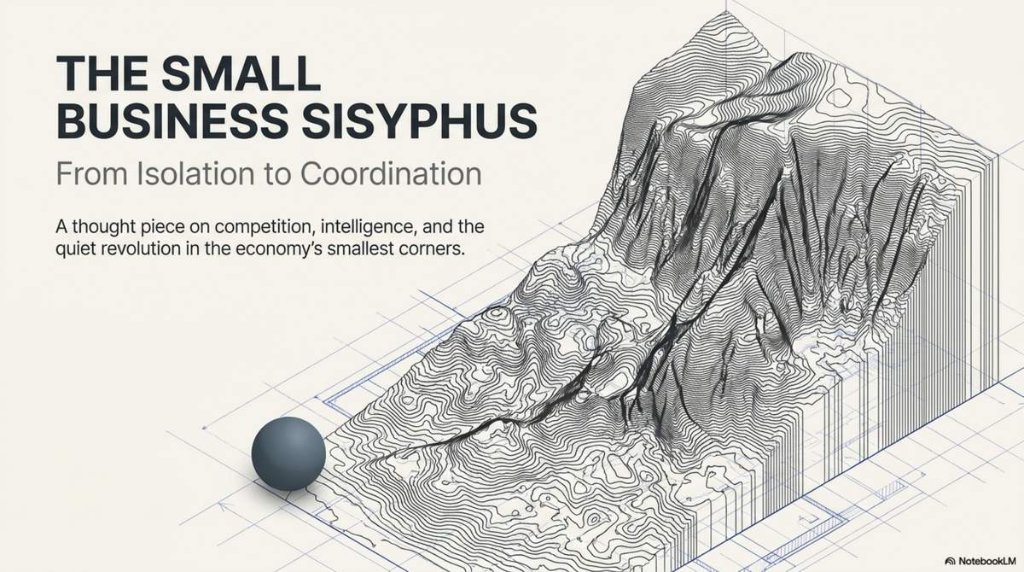
For as long as economists have studied small business, they have noticed an uncomfortable paradox: the people who take the most personal risk in the economy — who mortgage homes, forego salaries, and wager years of their lives — are also the ones with the least access to the tools that might make their gamble succeed.
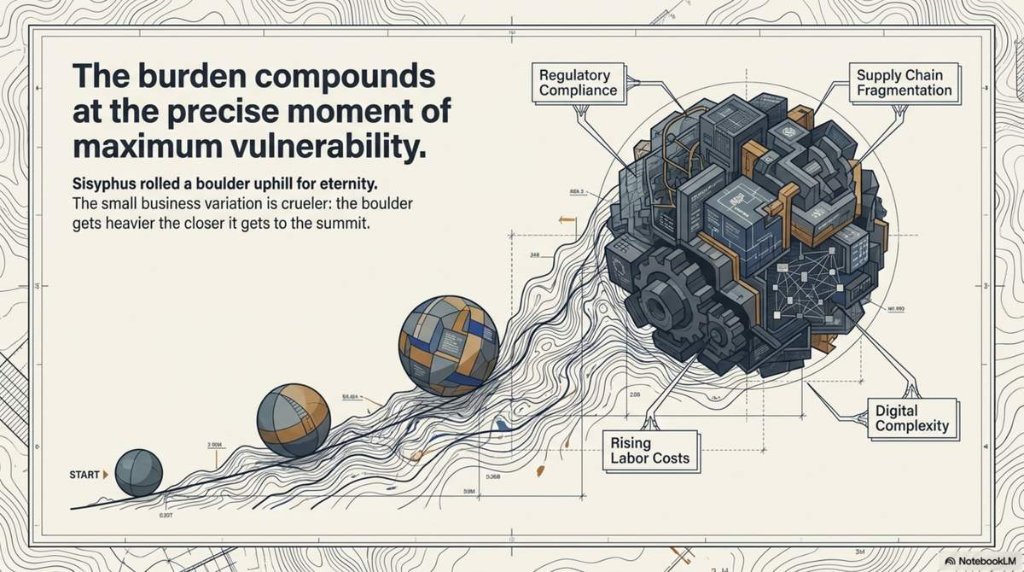
The analogy is a Greek one. Sisyphus, condemned by the gods to roll a boulder uphill for eternity, only to watch it roll back before he reaches the top, has become shorthand for futile effort. But the small business version faces a crueler variation: the boulder gets heavier the closer he gets to the summit. Regulatory compliance, supply chain fragmentation, rising labor costs, digital complexity — the demands of running a business concentrate precisely at the moments when a business is most vulnerable. This is not an accident. It is, in many ways, a feature of how markets have been structured for the past half-century.
The Advisory Gap No One Talks About
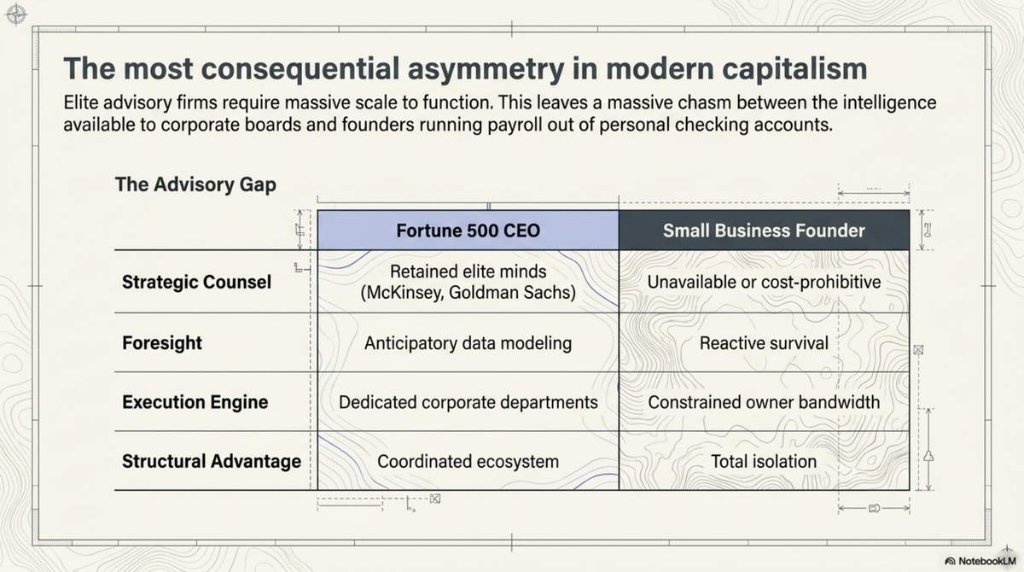
Elite advisory firms like McKinsey and Goldman Sachs were built, quite deliberately, for a different client altogether — and there is nothing wrong with that. Their model requires scale to function. The world's best strategic, legal, and financial minds have historically been available on a retainer that starts well above what most small businesses earn in a year.
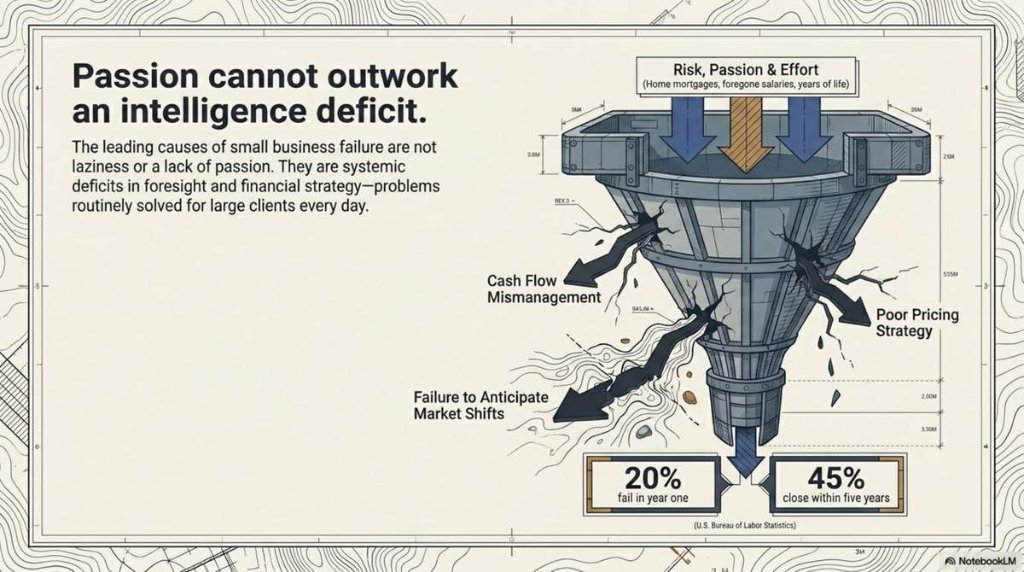
This advisory gap — the chasm between the intelligence available to a Fortune 500 CEO and what is available to a founder running payroll out of a personal checking account — is one of the most consequential and least discussed asymmetries in modern capitalism. Large firms do not simply have more money. They have better information, better counsel, better foresight. According to the U.S. Bureau of Labor Statistics, approximately 20 percent of new business establishments do not survive their first year, and roughly half close within five years. The leading causes are not laziness or lack of passion. They are cash flow mismanagement, poor pricing strategy, and failure to anticipate market shifts — problems that competent advisors routinely solve for large clients every single day.
Until very recently, there was no real solution to this problem.
The Warehouse and the Dark Store
To understand what is now changing, it helps to trace a short evolution in retail — one that illustrates how market shifts happen in waves, and how small businesses have repeatedly found themselves a wave behind.
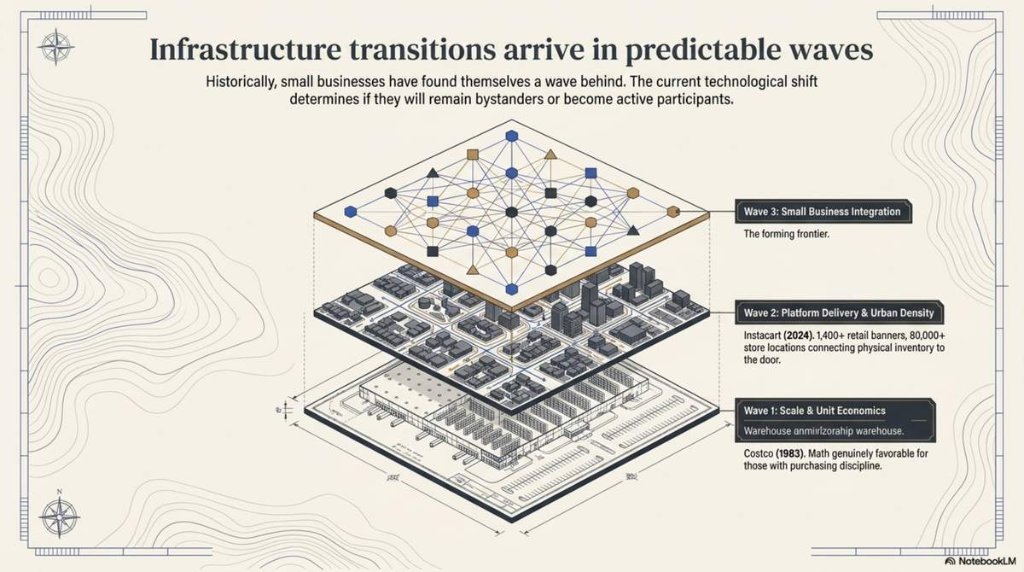
The first wave was the warehouse club. Costco, founded in 1983, proved that families would drive further and buy more if the unit economics were right. Industry analyses have consistently found Costco's per-unit prices on staple goods to run meaningfully below conventional grocery stores — a gap that, for households able to manage their purchasing discipline, makes the math genuinely favorable.
The second wave was digital convenience colliding with urban density. In cities where square footage is expensive and time is scarce, the Costco model breaks down. Into this gap stepped the "dark store" — a fulfillment center closed to the public, existing solely to fill delivery orders. Companies like Gorillas, Getir, and GoPuff built entire businesses around this model before the economics of ultra-fast delivery proved harder to sustain than the venture capital backing them. What matured in their wake was a steadier version of the same idea: platforms like Instacart, which by 2024 had partnerships with more than 1,400 retail banners across North America, connecting physical inventory directly to the customer's door.
The third wave — still forming — is whether small businesses can participate in this ecosystem as something other than bystanders.
The Invisible Wall
For most of the past decade, the honest answer was: not really.
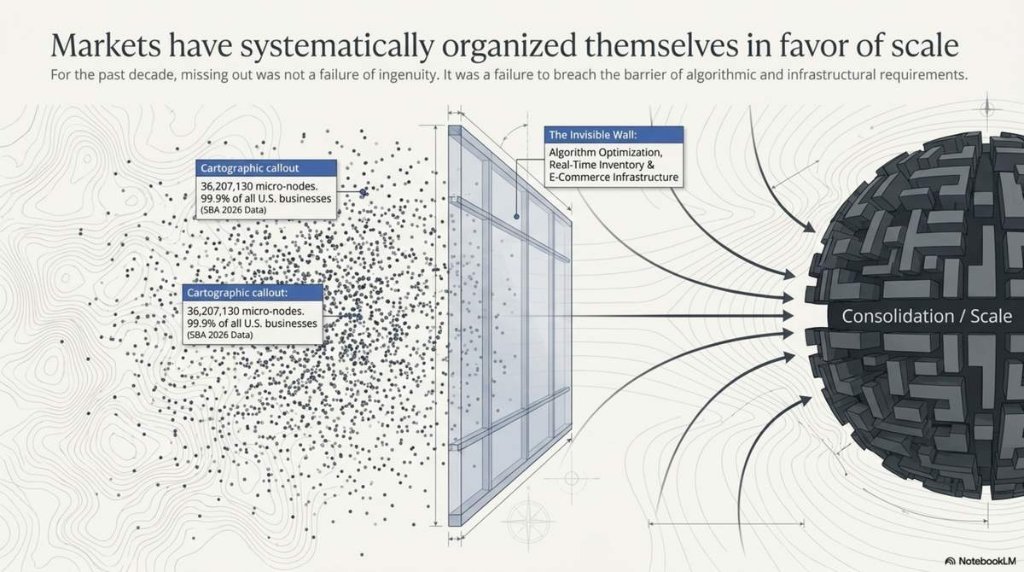
Competing on platforms like Instacart requires real-time inventory systems, e-commerce teams, and algorithm optimization budgets. Digital advertising requires analytics capabilities most small operators lack the bandwidth or budget to develop. The result was a gravitational pull toward consolidation. Big businesses got better at being big. Small businesses — the approximately 36 million firms that account for 99.9 percent of all U.S. businesses, according to the Small Business Administration's 2026 data — kept running harder for a smaller share of a market that kept organizing itself in favor of scale.
What was missing was not effort or ingenuity. What was missing was coordination — and intelligence.
The Quiet Arrival of the Great Equalizer
In roughly two years, something changed that has not yet been fully absorbed by mainstream economic commentary.
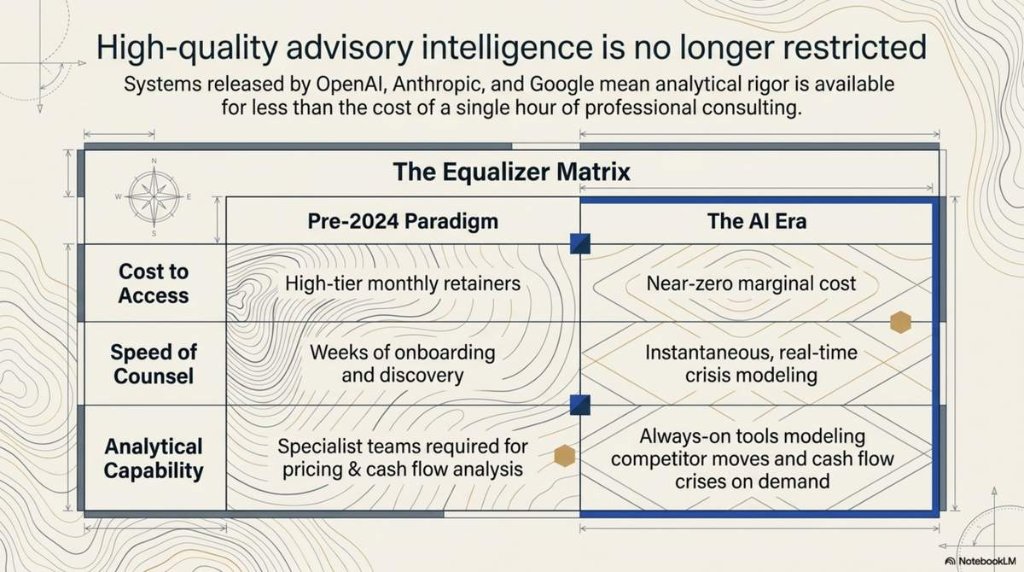
The AI systems released by OpenAI, Anthropic, Google, and others represent the first time in history that something approximating high-quality advisory intelligence has been made available at near-zero marginal cost to anyone with an internet connection. A small business owner can now, for less than the cost of a single hour of professional consulting, access tools that model pricing strategies, analyze competitors, and walk through a cash flow crisis with analytical rigor that would have required a specialist not long ago.
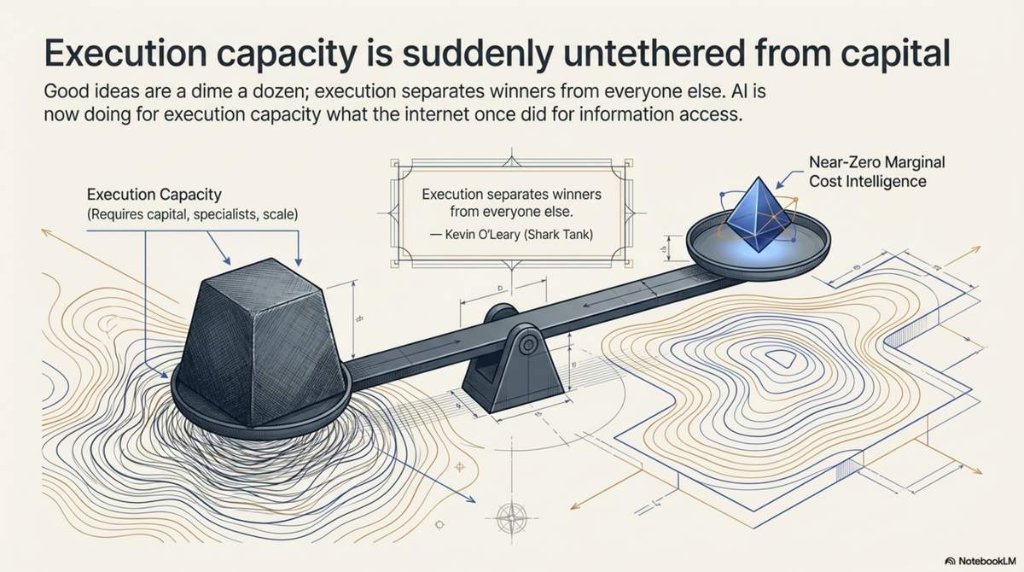
Kevin O'Leary, the investor known from Shark Tank, has long observed that good ideas are a dime a dozen — it is execution that separates winners from everyone else. The aphorism has always been true. What has changed is that AI is now doing for execution capacity what the internet once did for information access: distributing it, flattening the cost curve, and making available to the many what was previously reserved for the few.
The Coordination Advantage
Technology alone, however, does not close the gap. The deeper insight — lost in both the hype and the fear-mongering dominating public conversation about AI — is about coordination.
Large businesses have always benefited from internal alignment: departments that share data, advisors who understand the whole picture. Small businesses, operating in isolation, have not. Each owner climbs the same hill, carries the same weight, without knowing that two streets over, another owner solved the same problem last quarter.
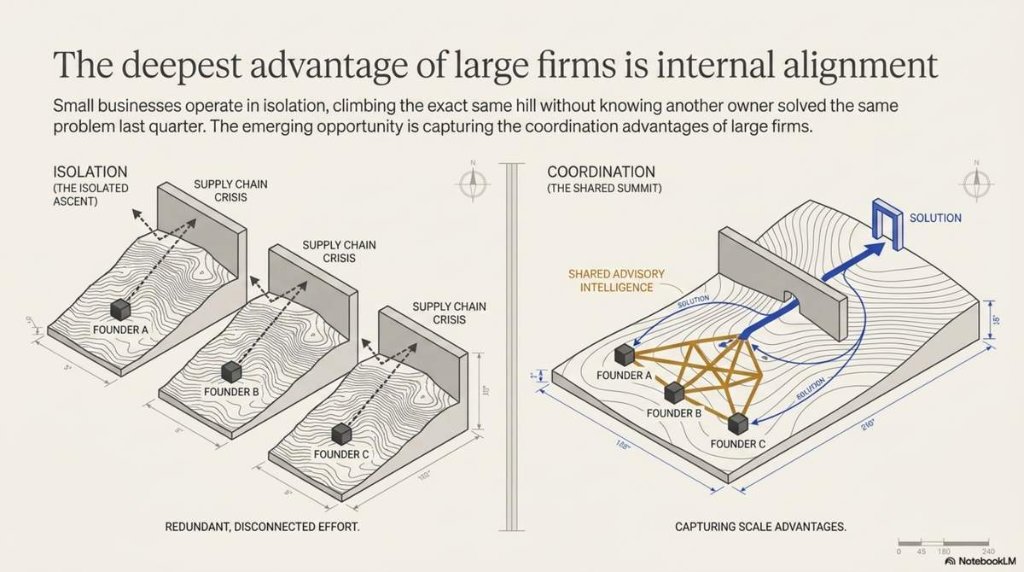
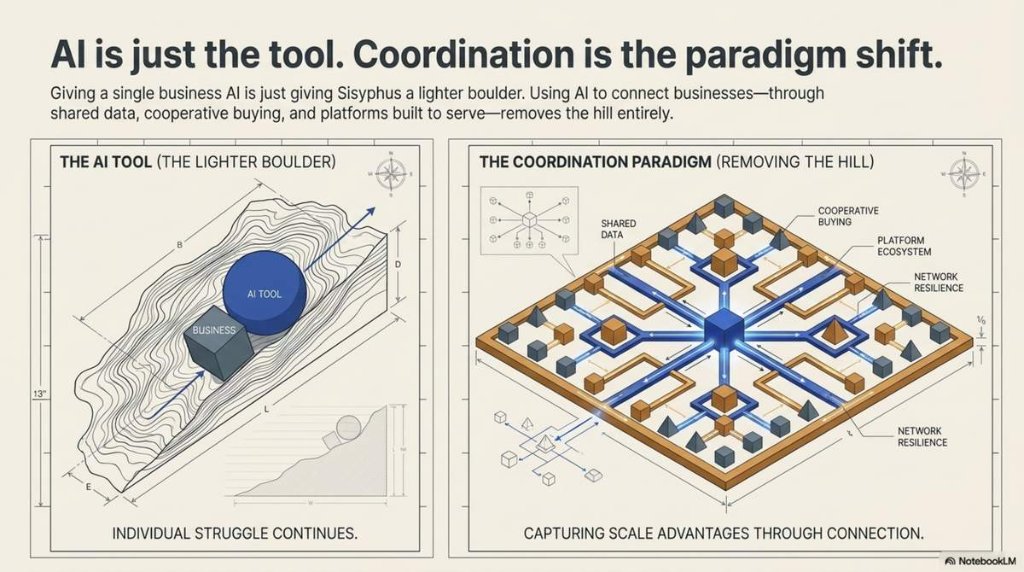
The emerging opportunity is for small businesses to capture coordination advantages large firms have always enjoyed — through shared advisors, cooperative buying, collective data, and platforms built to serve rather than extract. The technology has arrived. The business models and cultural shift to match it are still catching up.
A Word on the Fear
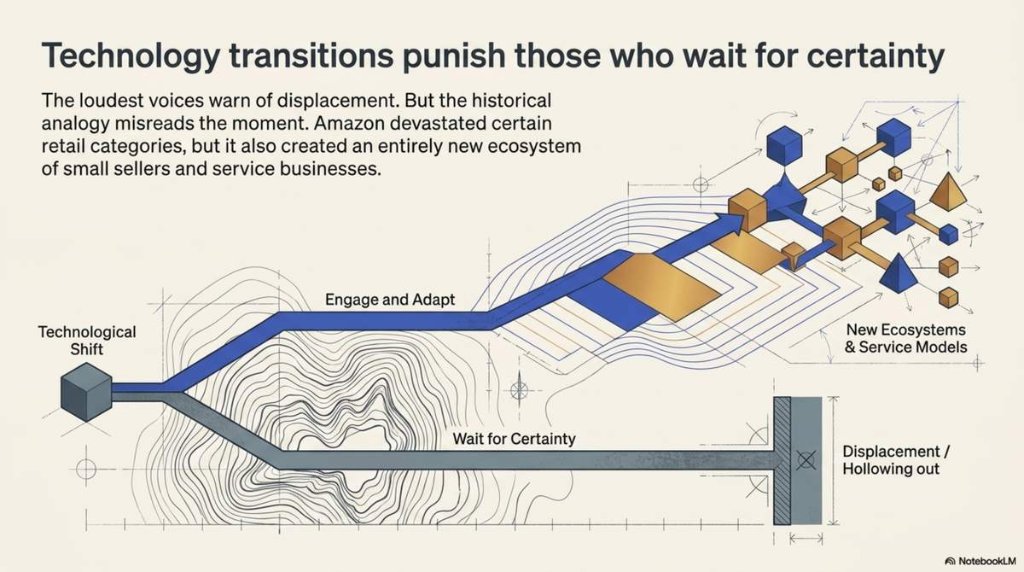
It would be negligent to ignore that the loudest voices in the current conversation are not optimistic ones. Across social media, a genre of content warns that AI will hollow out industries and leave small operators with nothing. Some of these concerns are legitimate. Displacement is real, and the transition will not be costless.
But the historical analogy most often invoked — that AI is coming for small business the way Amazon came for independent retail — misreads the moment. Amazon devastated certain retail categories. It also created an entire ecosystem of small sellers and service businesses that did not previously exist. Technology transitions have never been kind to those who wait for certainty before acting.
The Work Ahead
The advisory intelligence once locked inside firms with names carved in marble above the door is now available at the push of a button. The coordination infrastructure that once required a large organization to build can now be assembled by a small team. The question is not whether these capabilities exist. They do. The question is who picks them up.
For small businesses willing to engage — to treat this moment not as a threat to survive but as an opening to seize — the landscape ahead looks less like a hill and more like a clearing.
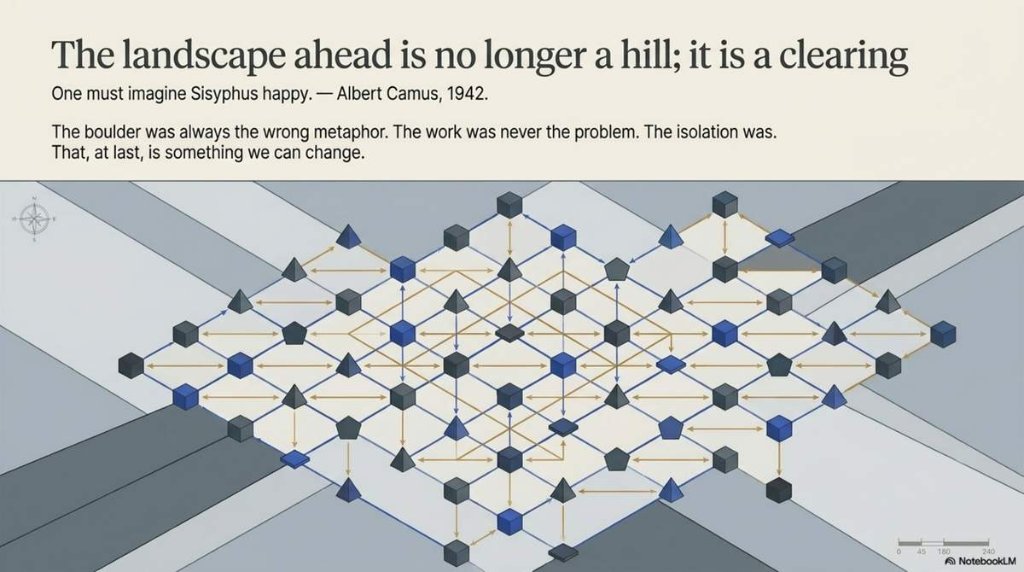
"Sisyphus, as Albert Camus wrote in The Myth of Sisyphus (1942), must be imagined happy. The boulder was always the wrong metaphor. The work was never the problem. The isolation was.
That, at last, may be something we can change."
◆ Sources
- U.S. Bureau of Labor Statistics, Business Employment Dynamics — survival rates of new business establishments.
- U.S. Small Business Administration, Small Business FAQ (2026) — 36,207,130 small businesses representing 99.9% of all U.S. firms.
- Instacart Newsroom — partnerships with more than 1,400 retail banners and 80,000+ store locations across North America.
- Kevin O'Leary, recurring commentary on ABC's Shark Tank.
- Albert Camus, The Myth of Sisyphus, Gallimard (1942); English translation, Vintage Books (1955).
◆ The work continues
Bibeka exists because that combination wasn't available at the scale owner-operators need.
Start a Conversation© 2026 Bibeka Advisory · All rights reserved.